





Section 2
The success of Indian political campaigns is increasingly being determined by the amount of money being pumped into the campaign. As a result, Rs 55,000 and Rs 60,000 crores (8 billion) were spent on the 2019 Lok Sabha and assembly elections in India. In the largest democracy in the world, it means the cost of a vote in current times is roughly Rs 700. In comparison, the entire USA election campaign was Rs 28,200 crores. USA campaigns spent less than half of the total expenditure during the Indian elections
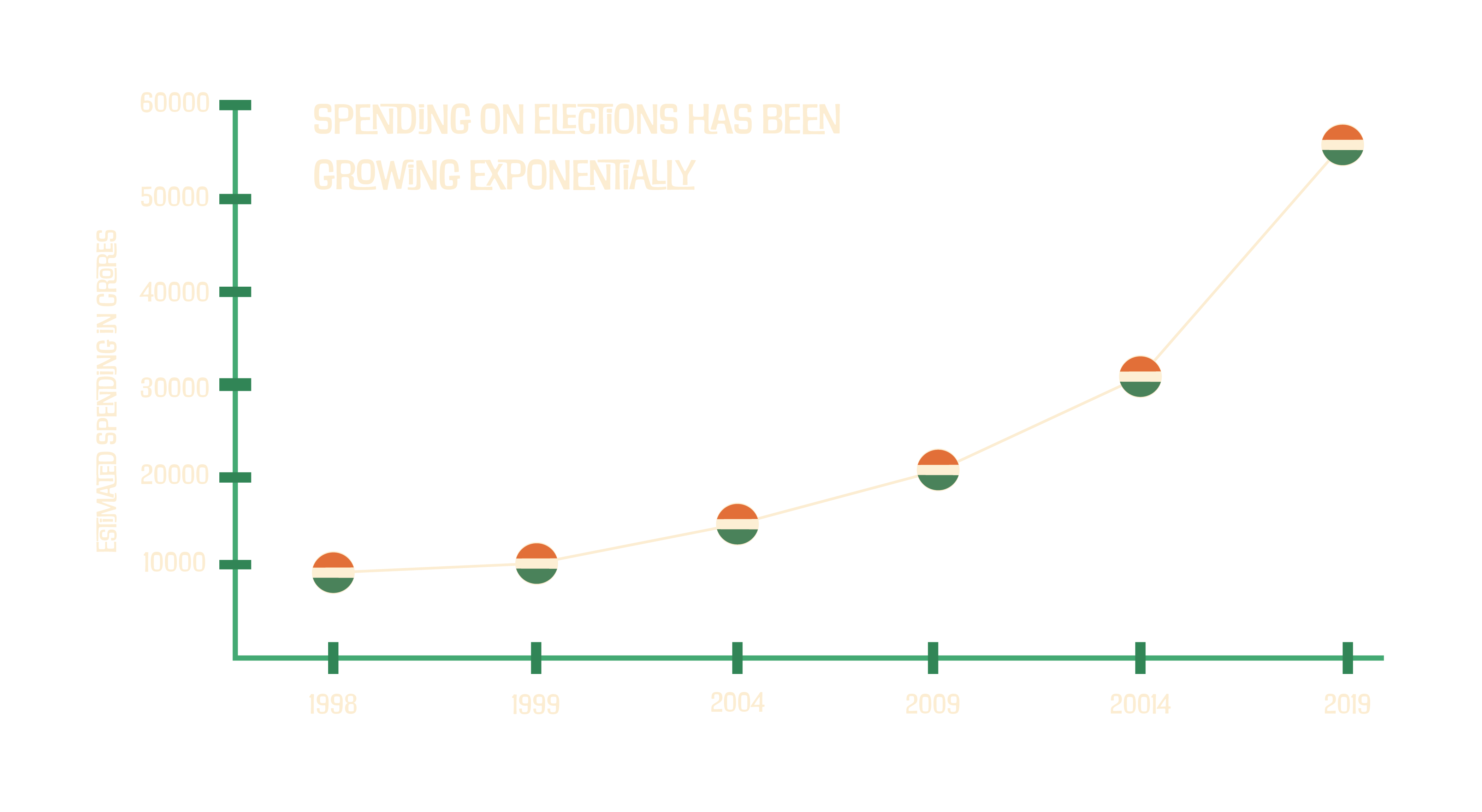
All of this money highlights 4 main problems:
Lack of effective oversight by the Election Commission of India (ECI) has allowed candidates to flout spending limits without much fear of being caught, according to politicians and election experts. In 2019, Authorities said they had seized goods and cash worth about $456 million since March 26, more than twice the amount seized in the entire 2014 election.
India’s rules governing political contributions are looser than other major democracies. In the U.K., companies aren’t directly allowed to make donations to political parties. The U.S. allows unlimited funding through political action committees called super PACs on federal election campaigns, but requires them to disclose the names of donors.
In this game, money literally determines who the winner is.
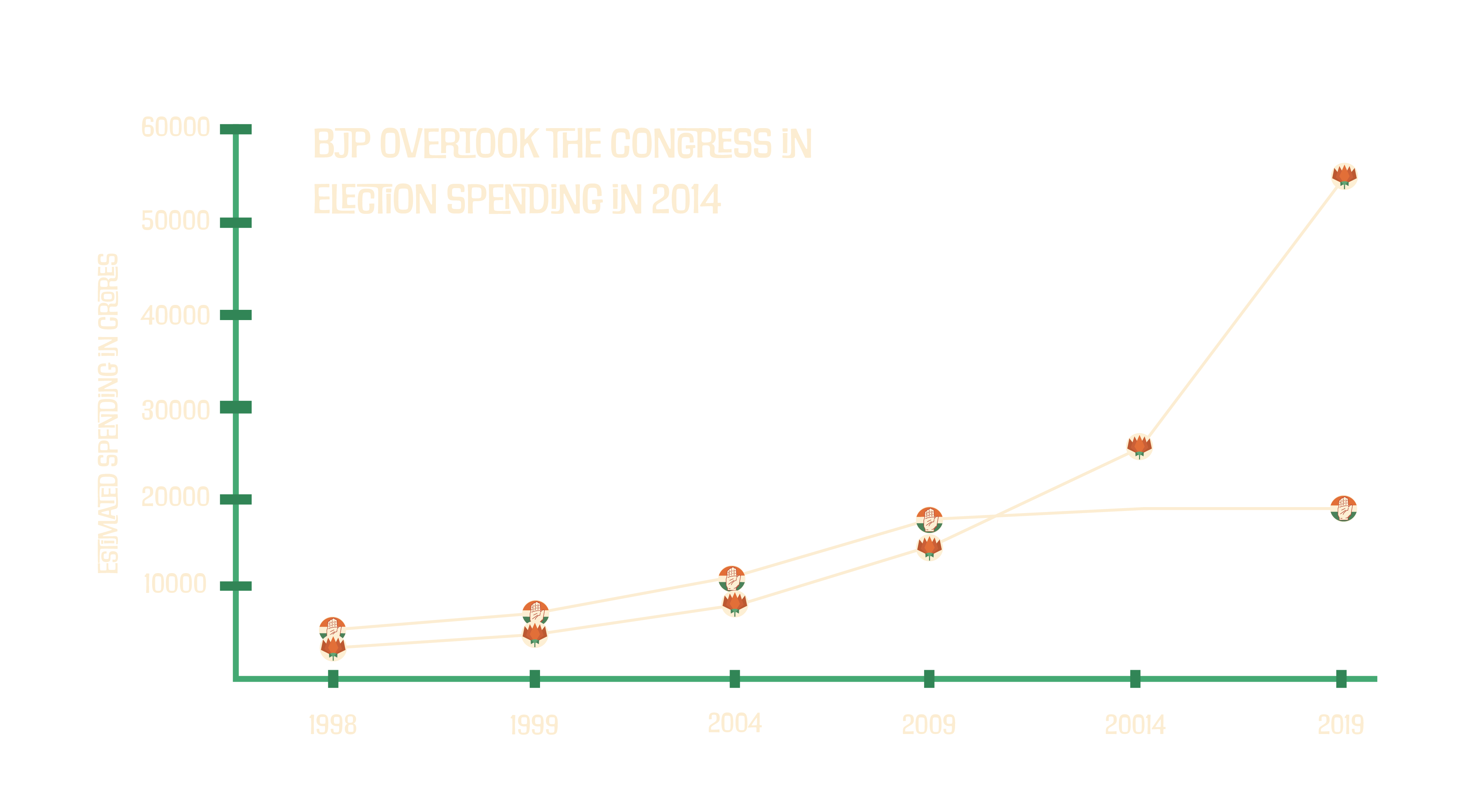
BJP overtook INC in spending at the same time that they won that election. Their spending has increasingly grown and they have dominated all media since then.
About 45%-55% of the total spending on the 2019 elections was by the Bharatiya Janata Party (BJP). That comes to Rs 24,750 crore-Rs 30,250 crore. This is more than what was spent on the entire USA election
As a result, Indian national politics has been dominated by 5 majority parties since its independence in 1947.
“Most legislators embark on their parliamentary career with a gross lie – the false election returns which they submit” - Atal Behari Vajpayee (Former Prime Minister)
In 2014, the top 1% earners in India were paid 22% of the national income. In a system with such staggeringly high inequality, a election fuelled by political funding only amplifies the preferences of the rich. The top 5 companies that donate to the campaign cumulatively provide Rs 148.5 crores in 2019.
“Money allows wealthy individuals or interests to influence electoral politics in their favour, thereby entrenching their wealth and creating a reinforcing cycle in which inequality and public policies interlock” - Devesh Kapur and Milan Vaishnav (authors of Costs of Democracy)
There is no denying that money, especially unaccounted cash flowing from groups and individuals with business interests, has often played a sinister role in the campaigns of candidates.
“In most advanced democracies, transparency is a core principle. Few advanced democracies legitimize opacity in the way India has done.” - Milan Vaishnav, Washington-based senior fellow at the Carnegie Endowment for International Peace
Individuals and corporations donate to Indian political parties, but lack of transparency makes it impossible to follow the money trail.
Section 3
“What is this if not the auctioning of our democracy to the highest-paying corporation?” - N. Bhaskara Rao
Section 4
Some of the biggest disadvantages of the corporate funding are the use of fake companies to route black money and the influence of people and companies over political parties to which they provide funds. There are various gaps in Indian rules, the benefit of which political parties take to avoid any kind of reporting. Hidden sources of funding lead to more spending of funds in election campaigns, thus impacting the economy of the country. Parties invest such exorbitant funds into elections, it becomes impossible to break the cycle and thus only 5 parties have dominated Indian elections since independence.